
A customer testimonial video is a short film, usually 1 to 4 minutes, in which a real customer explains the problem they had, why they chose a product and what changed after. For B2B startups it is the closest thing to a reference call that a buyer can watch at any time.
The examples on this page come from Engineer Stories, our testimonial series for Lyra. The engineer is the customer and Lyra is the product, so every beat of a B2B testimonial is there: who they are, why they chose it, what changed and the objection they want to clear up.
A testimonial, taken apart
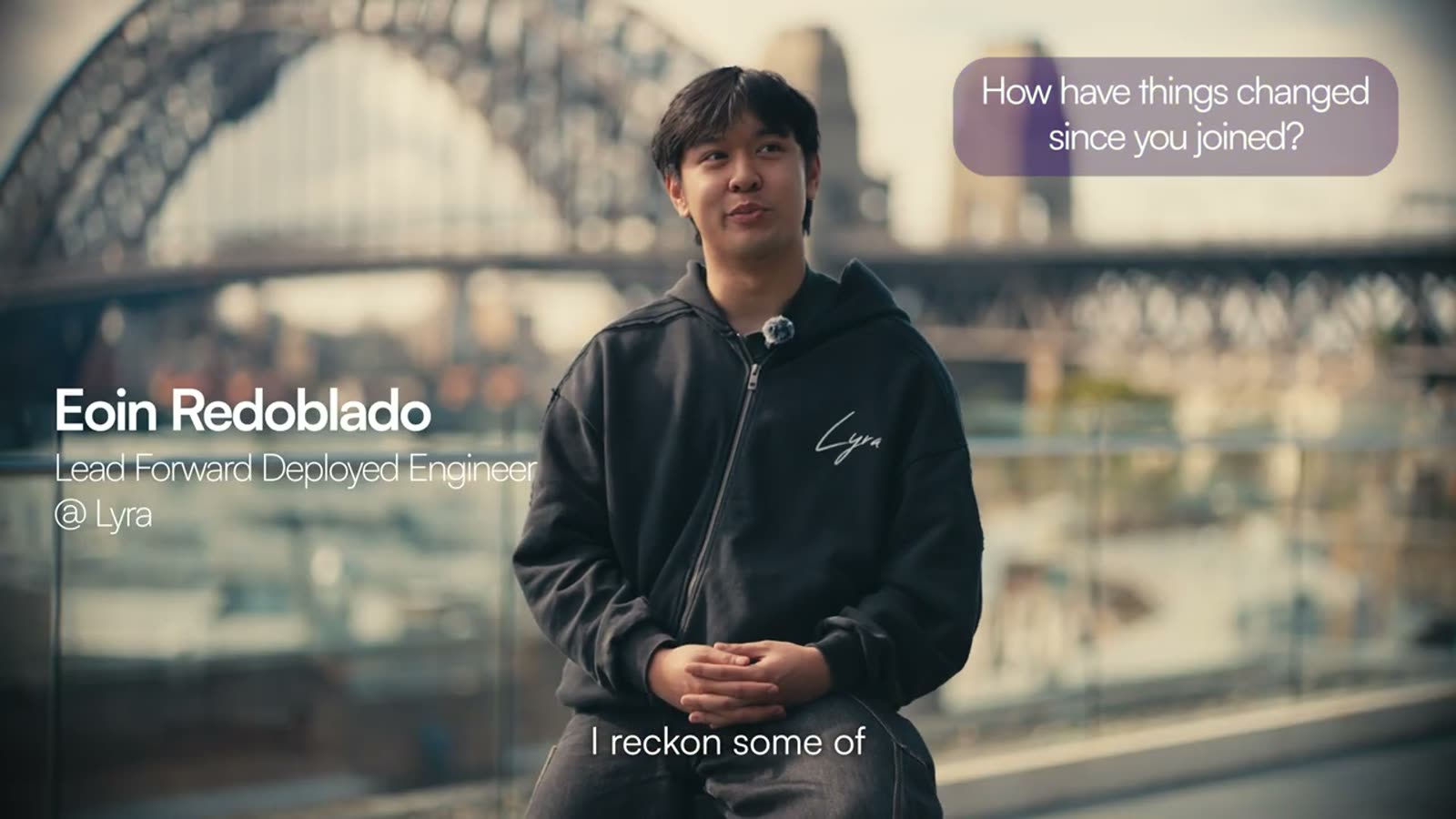
- Name and role on screen. Eoin is introduced as Lead Forward Deployed Engineer at Lyra the moment he first speaks. Viewers never wonder who is talking.
- The question, on screen. "How have things changed since you joined?" Each question becomes a title card, so the film reads as chapters even with the sound off.
- Shot where the story happens. The Harbour Bridge behind him says Sydney before he does. Location does half the work of credibility.
- Captions burned in. Most people watch in a feed with the sound off. Every line is captioned in the edit, not left to auto-captions.
- The brand, without a logo slide. The Lyra hoodie is the only branding in the frame. It reads as real, not as an ad.
What great testimonials have in common
You know who is talking, and what they work on
Eoin works on Paraform, so the film shows Paraform. Edward's client is ReadMe, so we show ReadMe.
- 0:07
Name first
Eoin's lower third lands with his first line: "Since I joined Lyra, April 2024, third year in uni."
- 0:13
Then the product
A cutaway to Paraform as he explains what the platform does. Show it, don't describe it.
- 0:13
Same beat, different client
Edward's film cuts to ReadMe's onboarding flow, the project he is rebuilding.
A specific turning point
Eoin's is an Instagram story about an 88rising project. Edward's is Lyra's social media. Specific beats generic every time.
- 1:07
The specific trigger
"I saw on his Instagram story that he worked on this really cool project for 88rising." The edit puts 88rising on screen as he says it.
- 0:41
Their words, the real post
"I saw Lyra on social media." The cutaway is one of Lyra's own posts.
A before and after you can picture
Eoin: around four people in Sydney when he joined, eighty now. Edward: a new office on Collins Street in Melbourne.
- 0:43
Before
"When I joined, there was only around four including myself." The edit cuts to the office as he says it.
- 0:21
After
The new Melbourne office on Collins Street, on screen while he says it.
- 3:19
The result, in the room
A packed community night, so "a really great community" is something you see, not something you're told.
The doubt, answered by the customer
Both engineers take on the same myth, that Lyra only builds MVPs, in their own words. A customer saying "that's not what happens" is worth more than any FAQ.
- 3:49
Name the myth
"One of the biggest things I've seen circulate online is the fact that Lyra kind of just builds MVPs."
- 2:13
Answer it with specifics
"Imagine Lyra comes in and takes it from one to 100."
Who to film
The person who felt the problem, not only the executive who signed. And one film is a data point; a series that looks and feels the same every time becomes something people follow.
- 0:01
Episode one
Every Engineer Stories film opens on the same title card.
- 0:01
Episode two
Same opener and the same questions, so viewers know what they're getting.
Where to film
Wherever their story actually happens. Their screens, their team and their space make it believable in a way a studio backdrop cannot.
- 1:31
With the client
A café meeting, cut in while Eoin talks about how often he speaks with his client.
- 1:01
Doing the work
Edward at his laptop as he walks through a normal day.
- 2:07
The life around it
The table tennis club he talks about, on screen as he mentions it.
Why production quality decides it
Buyers can tell a testimonial shot on a phone from one made properly, and they read that as a signal about the company. The difference is in what you barely notice: how the interview is lit and recorded, how the questions draw out a real answer instead of a rehearsed one, and how the edit finds the line that sells. Getting a customer to say something true, and making it look like it came from a company that has its act together, is the part we do.
Watch the full films: Eoin's engineer story and Edward's engineer story.
About Lyra Studio
At Lyra we believe simplicity is the key: one clear story, filmed in a day, with nothing on screen that does not need to be there. Lyra Studio is part of Lyra, the Sydney company behind the Australian engineering network that works with US startups, alongside Lyra Capital, which invests in them. Every film we make goes out through the Lyra network of founders, engineers and investors.
Questions
How long should a customer testimonial video be?
One to four minutes for the main film, plus 20 to 45-second shorts. Short enough to finish, long enough for a real before and after.
Should testimonial videos be scripted?
The structure should be planned, but the answers should not be read. A prep call sets the questions, and the interview stays conversational so it sounds like the customer.
Where is the best place to film a testimonial?
At the customer's own office or wherever their story happens, with b-roll of their team and screens. It makes the story credible to other buyers.
How many customers should we film?
Start with one strong story, then build a series. Several short testimonials in the same format can each answer a different objection buyers raise.